
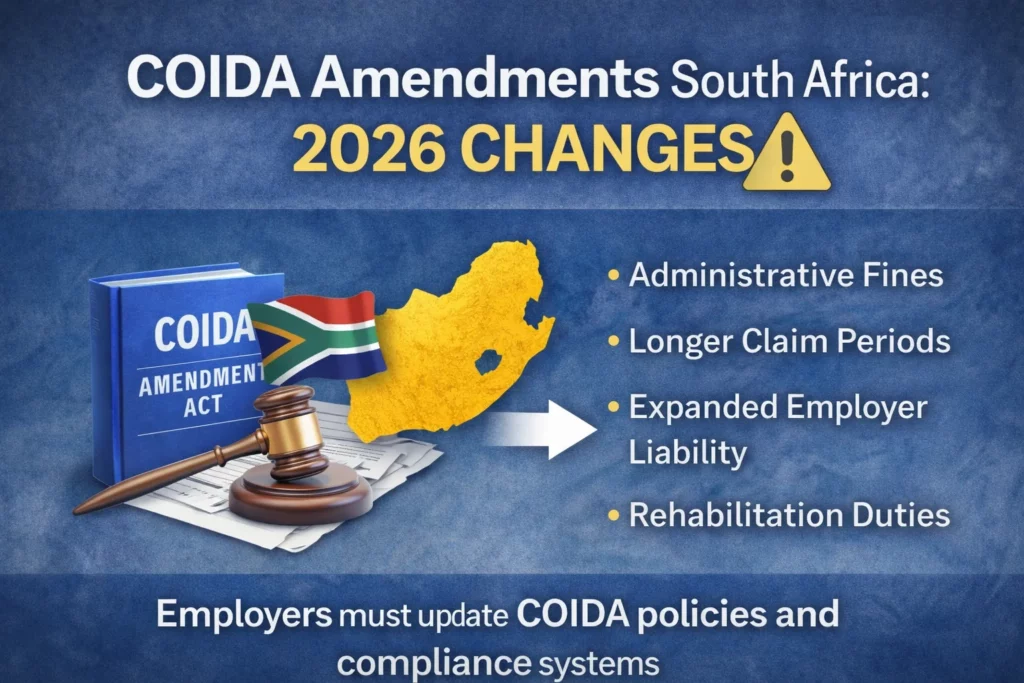
South Africa’s compensation and workplace injury framework has entered a new enforcement era. The COIDA Amendment Act (Act 10 of 2022) is now being implemented in phases from January 2026, introducing stricter compliance obligations, expanded employer liability, and administrative penalties with immediate financial consequences.
For employers, this marks a decisive shift away from reactive compliance toward formalised systems, documented controls, and enforceable accountability.
COIDA Amendments Now in Effect
Key provisions of the COIDA Amendment Act have officially commenced:
- 23 January 2026 – Core amendments took effect
- 1 February 2026 – Governance and Board-related provisions
- 1 April 2026 – Administrative penalties, assessment deadlines, and enforcement mechanisms
Because implementation is staggered, employers must understand which obligations are already enforceable and which become active from April.
Administrative Penalties Replace Criminal Prosecution
One of the most significant changes under COIDA law South Africa is the replacement of criminal prosecution with direct administrative penalties.
This enables faster enforcement and removes the delays traditionally associated with criminal courts.
Examples include:
- Failure to report an accident within 7 days may result in penalties equivalent to the full compensation amount, plus interest
- Failure to pay the first three months of temporary disability compensation may attract penalties of up to double the amount owed, plus interest
- Inadequate record-keeping may result in fines calculated as a percentage of annual employer assessments
For employers, poor administration is no longer a technical oversight — it is a financial risk.
Extended Prescription Period for Claims
Previously, COIDA claims prescribed after 12 months. Under the amendments, claims may now be submitted up to three years after the date of injury or diagnosis.
This significantly increases employer exposure and requires:
- Longer record retention periods
- More robust document management systems
- Greater preparedness for delayed claims and investigations
Expanded Employer Liability
Employer-Provided Transport
Where an employer arranges transport for employees — including shuttles or pooled transport — liability now extends from pick-up to drop-off, even when incidents occur outside the workplace.
Subcontractor Non-Compliance
If a subcontractor has failed to pay COIDA assessments, their employees may legally be deemed your employees, transferring liability directly to your organisation.
This places a clear duty on employers to verify subcontractor compliance.
Stronger Inspection and Enforcement Powers
Inspectors have been granted expanded authority under the amended framework, including the power to:
- Enter workplaces without prior notice
- Demand documents and question individuals under oath
- Issue compliance orders enforceable through the Labour Court
These powers apply across all workplaces, including private households employing domestic workers covered under COIDA.
Mandatory Focus on Rehabilitation and Return-to-Work
COIDA law now explicitly incorporates rehabilitation, reintegration, and return-to-work obligations.
Employers and the Compensation Fund are expected to support injured employees beyond financial compensation, including:
- Clinical rehabilitation
- Vocational rehabilitation
- Structured reintegration into the workplace
Employers that proactively implement rehabilitation programmes may qualify for assessment rebates, reinforcing compliance through incentive-based enforcement.
Expanded Definitions and Coverage
The amended legislation broadens recognised occupational injuries and diseases to include:
- Post-traumatic stress disorder (PTSD)
- Additional occupational diseases linked to workplace exposure
New documentation, reporting, and enforcement duties further raise the compliance threshold for employers.
Current COIDA Requirements Still Apply
Despite the amendments, the existing COIDA framework remains enforceable.
Employers must continue to ensure:
- Accurate accident reporting
- Proper documentation and record retention
- Timely payment of assessments and compensation
Failure to comply remains subject to enforcement under both existing and amended provisions.
What Employers Should Do Now
To manage risk under COIDA law South Africa, employers should immediately:
- Audit accident reporting procedures and timelines
- Strengthen record-keeping and document retention systems
- Review temporary disability payment processes
- Assess employer-provided transport arrangements
- Verify COIDA compliance of all subcontractors
- Prepare for inspections and compliance orders
- Implement structured rehabilitation and return-to-work frameworks
The Bottom Line
The COIDA amendments represent a fundamental shift toward administrative enforcement, extended liability, and proactive compliance. Employers that rely on outdated systems or informal processes face increased exposure to penalties, delayed claims, and enforcement action.
Early compliance assessment and system-based governance are now essential.Katope Consultancy assists employers with COIDA compliance audits, risk assessments, and system-based occupational health and safety governance aligned with current and emerging legislation.